
It is the question that comes up on nearly every first site visit: should this be a paver patio or a poured concrete slab? Both will give you a flat, usable surface. Both are sold as durable. The honest answer is that they fail differently, and in Northeast Florida the way a surface fails matters more than the way it looks on day one.
Here is how the two actually compare on the ground in St. Augustine and St. Johns County.
A poured slab is one continuous piece of concrete. It is strong in the way a single large plate is strong, and it moves as one object. When the ground beneath it shifts, the slab cannot flex with it. Something has to give, and what gives is the concrete itself. That is why slabs are poured with control joints cut into them: the joints are there to decide where the cracking happens, because the question was never whether it would crack.
A paver patio is a segmental system. It is not one surface, it is a few hundred individual units sitting on a compacted aggregate base, held together at the edges by restraint and locked in the field by jointing sand. Minor ground movement gets absorbed across many small joints rather than concentrated into one crack line.
That single structural difference drives almost everything else on this list.
Sandy soil drains beautifully and supports poorly. Those two facts get confused constantly.
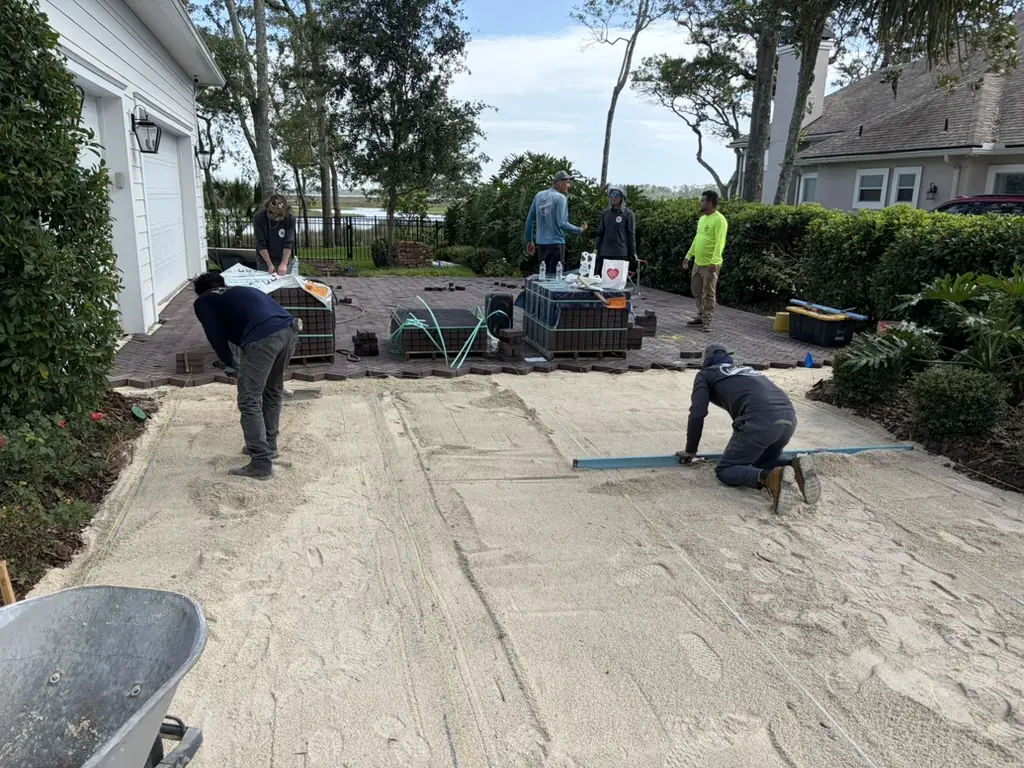
Water moves through sand fast, which is genuinely useful. What sand does not do is hold load. It moves under weight, it migrates when water runs through it, and it settles unevenly as it consolidates. A surface set on sand that was raked flat rather than properly excavated and compacted will move. It is not a question of workmanship pride, it is soil mechanics.
This is where both systems live or die, and it is the part of the job that is invisible once the work is finished. Base depth gets set from what is actually under a given yard, established on site rather than assumed from a standard spec, then built up and compacted in lifts rather than dumped and levelled in one pass. A patio installed correctly on a properly built base will outlast one installed on a thin setting layer by years, regardless of which surface material sits on top.
Where the two diverge is what happens when settlement occurs anyway, because on some sites it will.
When a section of paver patio settles, the pavers in that area are lifted, the base beneath is corrected and recompacted, and the same units go back down. Done properly the repair is invisible, because the material is the material you already had.
When a poured slab cracks or a corner drops, the options are worse. A patch is structurally fine and cosmetically obvious. New concrete does not match old concrete, and it never will; cure date, mix, and years of weathering all show. Colour-matching a patch on a stamped or tinted slab is harder still. The alternative is breaking out and repouring a section, which means demolition noise, access for equipment, and a visible seam anyway.
This is the single most common regret we hear from homeowners who inherited a slab. Not that it cracked, but that there was no good way to fix it once it did.
Close to the water, the surface material is rarely what fails first. Concrete pavers and travertine both handle salt air well. What suffers is metal: edge restraint spikes, fasteners, and any hardware built into a seating wall or a step. Those should be specified for coastal exposure from the start on a coastal lot. Substituting a standard fixing to save a few dollars is a decision you meet again in five years.
Heat is worth thinking about separately. Anything in full afternoon sun gets hot underfoot, and lighter materials run cooler than darker ones. Travertine stays noticeably cooler than most concrete products, which is why it turns up so often around pools.
One thing to be clear about, because it gets marketed loosely: a standard paver patio is not a permeable paving system. Water drains at the joints far better than it does off a sealed slab, but a true permeable system (PICP) is a different build, with an open-graded base and open jointing aggregate designed to take water into the ground. If stormwater handling is the actual goal, that is a specific system to ask for by name, not something a normal paver patio does by accident.
This is not a case against concrete. A poured slab is often the right call for a utility pad, a shed base, a straight side-yard run where appearance is not the point, or a job where the budget genuinely will not stretch and the surface is a means to an end.
Concrete also does large uninterrupted expanses more cheaply. If you want a very big, very plain surface and you accept that it will eventually crack somewhere, a slab does that job for less money per square foot.
What we would not recommend is choosing a slab for an entertaining space you plan to keep for fifteen years, on a sandy lot, because it looked cheaper on the quote. The cost difference narrows considerably once you price in the first repair.
Three questions get most people to an answer.
How long do you plan to be in the house? Short horizon changes the maths. If you are selling in two years, the repairability argument matters less to you than it does to the next owner.
What is the space for? A surface you will sit on, eat on, and look at from the kitchen window earns a different budget than a pad for a generator.
What is under the yard? This one you cannot answer from a photograph, and it is the reason we walk the property before quoting. Access, grade, existing drainage patterns and what the soil is actually doing all change the build, and sometimes they change the recommendation.
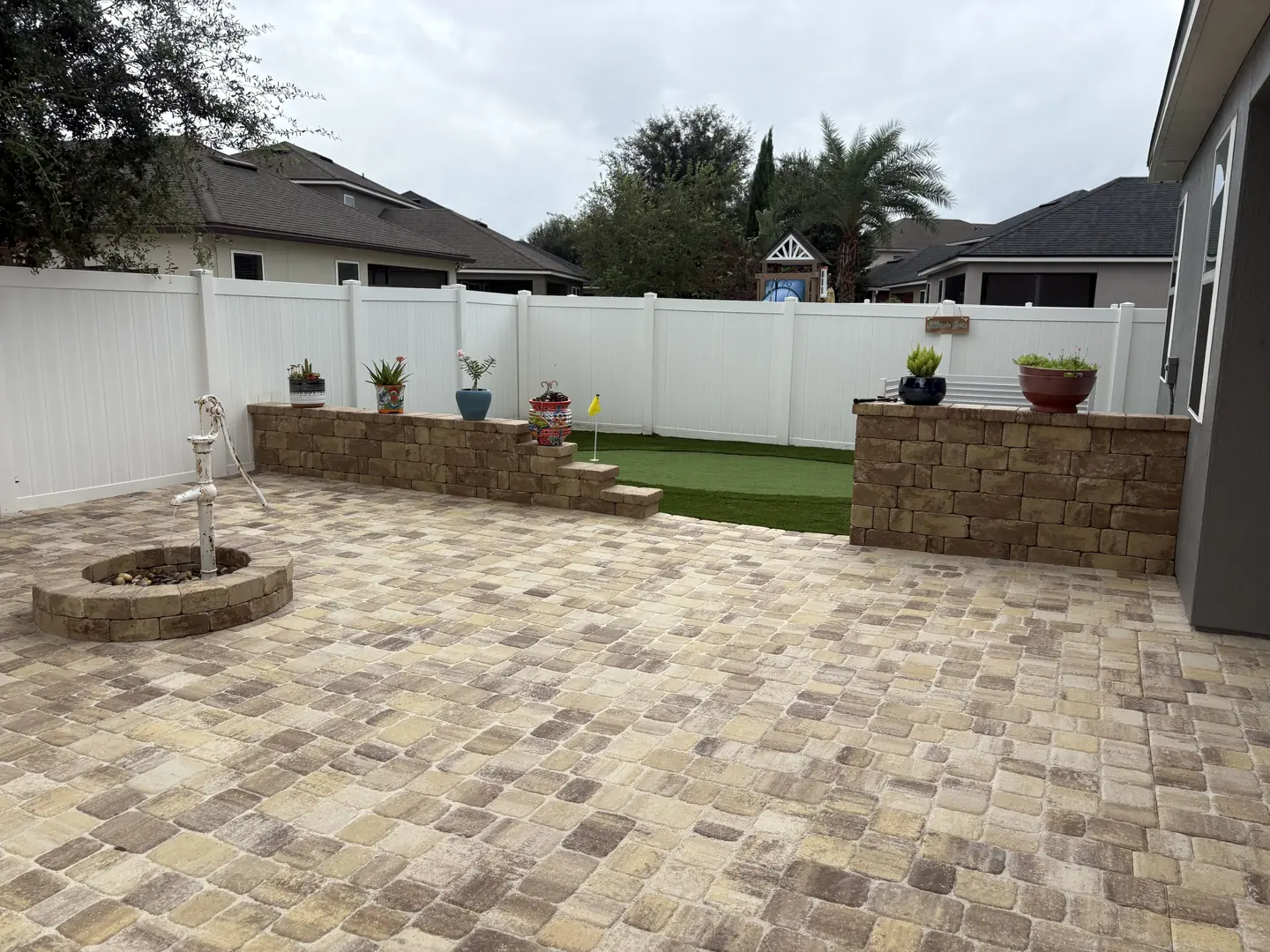
Not if the base is built correctly. Sand alone is not a base, however firm it feels underfoot. Patios that sink are almost always ones set on a thin screeded layer to save time on excavation. Where settlement does occur, individual pavers can be lifted, the base corrected, and the same units reset.
Slightly, and it is minor. Sweep it, rinse it, pull the occasional weed from a joint, and top up polymeric joint sand every few years as it settles. Sealing is optional and mostly about appearance. A concrete slab needs less routine attention but gives you far worse options when something does go wrong.
Sometimes, but it is not usually the right answer. Laying over a slab raises the finished height, which causes problems at door thresholds and where the surface meets the house. It also means you have built on top of a base you did not inspect. More often the slab comes out and the base is rebuilt to the depth the soil actually needs.
Both can last decades when built properly, so the more useful question is what condition each will be in along the way. A paver patio can be returned to as-new condition in sections, indefinitely. A slab accumulates cracks and patches that cannot be undone.
A well-built paver patio generally presents better at sale than an ageing slab, largely because it can be made to look new again. We would not claim a specific figure for return on investment, because the honest answer depends on your market, your house, and the quality of the installation.
Helm Outdoor Solutions designs and installs paver patios and wider hardscape work across St. Augustine, St. Johns County and select Jacksonville neighborhoods. Every quote follows a walk of the property, because access, grade and soil decide the build.
If you are weighing this up for a specific address, the local pages go into the conditions that come up in each area: paver patios in St. Augustine and paver patios in Julington Creek are good places to start.
Call (904) 788-9464 or send us your project details for a written, site-specific estimate.