
Almost every conversation about a patio starts with the surface. Which paver, which colour, which pattern. Fair enough, it is the part you look at. But the reason one patio still sits flat after ten years and another has a dip by the back door has almost nothing to do with the paver on top.
It is what is underneath. Here is what is actually down there, and which parts matter most on Northeast Florida lots.
The layers, from the bottom up
A paver patio is not a surface, it is a small piece of pavement engineering. Four things sit under what you walk on.
The subgrade. The native soil, excavated to depth and compacted. Everything above it inherits its behaviour, which is why what the soil is doing on your lot changes the build.
The base. Compacted crushed aggregate. This is the structural layer, the part that spreads load and holds the shape. When people say a patio was built properly or built cheap, this is usually what they are talking about.
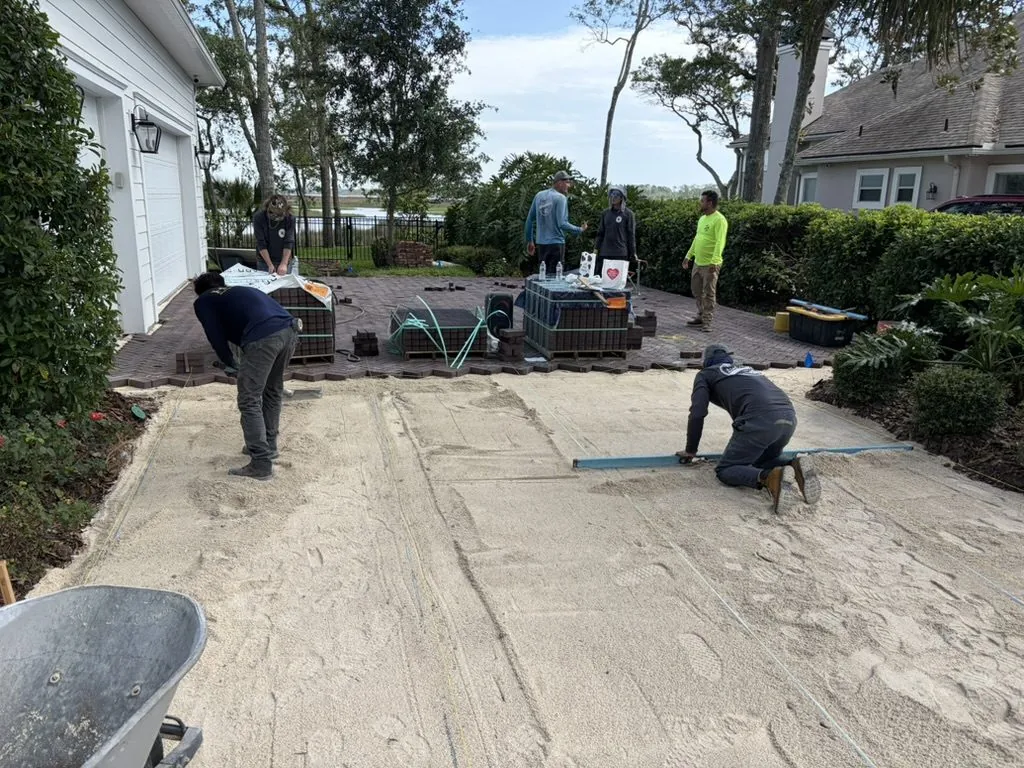
The bedding layer. A thin layer of coarse sand, roughly an inch, screeded flat so the pavers sit evenly.
The pavers and joint sand. The units themselves, with sand swept into the joints so they lock against each other rather than sitting as loose pieces.
Around the outside, edge restraint holds the whole field together. Without it the perimeter units creep outward, the joints open, and the failure works its way inward.
The single most common mistake
Using bedding sand to fix level.
If the base underneath is uneven, it is tempting to make up the difference with a deeper pocket of sand in the low spots. The finished patio looks perfect on handover day. Then that deeper sand consolidates under load at a different rate than the shallower sand beside it, and within a season or two you have a visible dip exactly where the shortcut was.
Bedding sand exists to let the pavers seat evenly. It is not a levelling compound and it is not structure. Level comes from the base.
Why base depth is not one number
People often want a single figure for how deep a base should be. There is not one, and anybody who gives you a number before looking at the yard is quoting a habit rather than your property.
What moves it: what the subgrade is made of and how it behaves when wet, whether the area will only take foot traffic or occasionally a vehicle, how water currently moves across the site, and whether the patio sits against a structure or free in the yard. A patio off a lanai on stable ground and a patio on a low corner that holds water after summer storms are not the same build, even at the same square footage.
Sandy soil complicates this in a way that catches people out. It drains quickly, which is genuinely useful, and it feels firm underfoot, which is misleading. Sand moves under sustained load and migrates when water runs through it. Firm is not the same as stable.
Compaction in lifts
Base material gets built up in layers and compacted at each stage rather than filled to depth and compacted once at the top.
The reason is simple. A plate compactor only influences so far down. Fill the whole depth and run the machine over the surface and you get a well compacted top few inches sitting on loose material underneath. It passes inspection by eye and fails slowly, from the bottom, where nobody can see it.
This is invisible in a finished photograph, which is exactly why it is worth asking about before work starts rather than after.
Grade, and where the water actually goes
A patio should shed water deliberately. That means a slight, consistent fall away from the house toward somewhere that can take the water.
On the flat lots common around here, that somewhere needs identifying before anyone breaks ground. Pushing runoff toward a neighbour, into a preserve buffer, or at the base of a foundation are all ways to solve a puddle and create a bigger problem. Getting this right is a site decision, made by walking the property, not something that can be specified from a plan or a satellite image.
What failure tells you
Patios usually tell you what went wrong if you know what you are looking at.
A localised dip, often near a door or under the furniture. Bedding sand used to correct level, or a soft spot in the subgrade that was not addressed.
The perimeter spreading and joints opening at the edges. Edge restraint missing, undersized, or fixed with something that has corroded.
Broad settlement across a whole section. Base depth or compaction, usually compaction.
Standing water after rain. Grade, and occasionally a base that has become saturated because there was nowhere for water to go.
The useful part is that all of these are repairable on a paver patio. The units lift, the base gets corrected, the same pavers go back down. That is the structural argument for segmental paving over a slab, and it only pays off if the repair is done to the cause rather than the symptom.
What to ask before work starts
Three questions get you most of the way.
What depth is the base going to, and what did you see on site that decided it? Will the base be compacted in lifts? Where is water going to go once this surface exists?
Any contractor who builds properly will have answers ready, because these are the decisions the job is actually made of.
Common questions
Can a sinking patio be fixed without replacing it?
Usually yes. The affected pavers are lifted, the base beneath is corrected and recompacted, and the same units are reset. What matters is diagnosing why it settled first, because resetting pavers over the same unresolved soft spot buys you a couple of years at most.
Does a patio need a base if the soil is already sand?
Yes. This is the most common misunderstanding we hear. Sand drains well and supports poorly. A compacted aggregate base is what carries load and holds shape, and sand does not do that job regardless of how firm it feels when you walk on it.
How long should a paver patio last?
Decades, when the base is right. The variable is not the paver, it is what is underneath and whether water was given somewhere to go. A patio built well and maintained lightly outlasts most of the furniture that goes on it.
Is polymeric joint sand necessary?
It is not structural, but it helps. It resists washout, slows weed growth in the joints, and keeps the interlock working. It settles over time and wants topping up every few years, which is most of the maintenance a paver patio ever asks for.
Have the conversation on site
Helm Outdoor Solutions builds paver patios across St. Augustine, St. Johns County and select Jacksonville neighborhoods, and every quote follows a walk of the property because base depth, access and drainage are decided there.
Conditions vary more than people expect between neighborhoods. The local pages cover what tends to come up in each: paver patios in RiverTown and paver patios in Deerwood.
Call (904) 915-3667 or send us your project details for a written, site-specific estimate.