
A driveway looks like a bigger patio. It is not. The moment a surface has to carry vehicles instead of furniture, almost every decision underneath it changes, and the ones that get skipped are the ones that show up as rutting and spreading two or three years in.
Here is what actually differs, and what it means if you are weighing a paver driveway for a St. Johns County property.
Load is the whole story
A patio carries people, a table and some chairs, spread fairly evenly and rarely moving. A driveway carries a few thousand pounds concentrated on four contact patches, arriving and leaving every day, turning, braking, and occasionally being joined by a delivery truck that nobody planned for.
That difference drives a deeper and more carefully compacted base. Not because the paver is weaker, but because the load path into the ground is completely different. A base that is perfectly adequate under a seating area will rut under repeated wheel loads in the same soil.
It also makes compaction non-negotiable rather than merely important. Loose material under a patio settles slowly. Loose material under a wheel track finds itself very quickly.
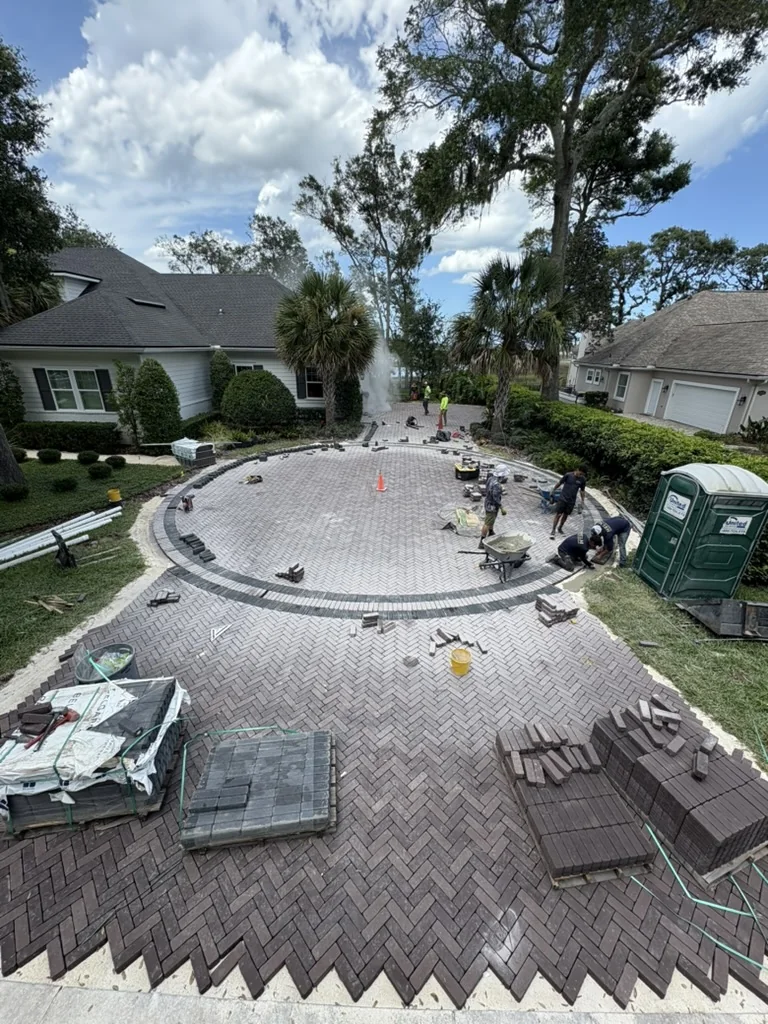
Pattern stops being decorative
On a patio, laying pattern is mostly an aesthetic decision. On a driveway it is structural.
Herringbone is the standard for vehicular paving because of how it resists horizontal movement. Wheels do not just push down, they push sideways under braking and turning. A running bond or stack pattern has continuous joint lines for that force to travel along, and the units creep. Herringbone interrupts those lines in both directions, so the field locks against itself.
You can still use a different pattern as a border or a decorative ribbon. The field that takes the tyres should be herringbone.
Edges matter more than people think
A patio usually has something holding at least part of its perimeter, a wall, a house, a step. A driveway is typically a wide surface with two long unsupported edges sitting against grass or a planting bed.
Every vehicle that clips the edge, every time someone parks slightly wide, pushes at that boundary. Without properly specified and properly fixed edge restraint, the outer course migrates outward, joints open, sand washes out, and the failure walks inward from there. Edge failure is the most common driveway problem we are called to look at, and it is almost always a specification decision rather than bad luck.
Turning circles and the approach
Where vehicles turn, they scrub. A circular drive, a parking spur, or a tight approach off the road concentrates that scrubbing in a predictable place, and that area wants extra attention in the base and the restraint.
The approach to the street is its own consideration. Work near the right of way can involve the county or the city depending on where your property line sits and what is being changed. That is worth confirming before anything is scheduled rather than discovering partway through, and it is one of the things we check when we walk the property.
Drainage on a large flat surface
A driveway is often the biggest hard surface on a residential lot. Whatever falls on it has to go somewhere, and on the flat ground common around here that somewhere needs deciding deliberately.
Sheeting water toward the garage door is the obvious failure. Less obvious is sending the whole volume into one corner of a lawn that then stays wet all summer, or pushing it toward a neighbour. Grade gets set so the surface sheds consistently toward ground that can actually take the volume.
Worth being precise here, because it is marketed loosely: a standard paver driveway is not a permeable paving system. Water drains at the joints considerably better than it runs off sealed concrete, but a true permeable build (PICP) uses an open-graded base and open jointing aggregate specifically designed to take water into the ground. If stormwater handling is the goal, that is a different system and worth asking for by name.
Where paver driveways earn their money
The repair argument is stronger on a driveway than anywhere else on a property.
Driveways take the most abuse of any surface on the lot, which means they are the most likely to eventually need something fixed. On a segmental surface, a settled wheel track or a stained section is a lift, correct and reset. The same problem in poured concrete is a patch that will never match, or a saw-cut and repour with a permanent seam through the most visible surface on your frontage.
Oil staining is worth mentioning for the same reason. A badly stained paver can be swapped for a spare. A badly stained slab is stained.
Common questions
Can pavers handle a heavy vehicle?
Yes, when the base is built for it. Segmental paving is used in commercial yards and port facilities precisely because it handles concentrated and repeated loads well. The material is rarely the limit. The base depth and the compaction are.
Will a paver driveway develop ruts?
Not if it was built for vehicle loading. Rutting in wheel tracks is the signature of a base built to patio depth, or a base that was filled to depth and compacted only at the surface. It is a build problem, not a paver problem.
Can I put pavers over my existing concrete driveway?
It is occasionally possible but usually the wrong answer. It raises the finished height, which causes issues at the garage threshold and where the drive meets the street, and it means building on a base nobody has inspected. If the concrete is already cracking, whatever caused that is still underneath.
How much maintenance does it need?
Rinse it, keep the joints topped up with sand every few years, and address oil promptly rather than letting it sit. That is most of it. Sealing is optional and largely about appearance and stain resistance.
Get it looked at properly
Helm Outdoor Solutions designs and installs paver driveways and wider hardscape work across St. Augustine, St. Johns County and select Jacksonville neighborhoods.
Base depth, edge detail, turning areas and where the water goes all get decided on site, which is why every quote follows a walk of the property rather than a measurement off a map.
Call (904) 915-3667 or send us your project details for a written, site-specific estimate.
Related reading
- What Goes Under a Paver Patio: Base, Bedding and Why Some Patios Sink, the base work a driveway shares with a patio.
- Paver Patio vs Concrete Slab: What Actually Holds Up in Northeast Florida, how pavers and concrete compare under load.