
The short answer: once the crew is on site, most residential paver patios are installed in about three to seven working days.
That is rarely the answer people actually want, though. What most homeowners mean is “when will my backyard be finished,” and the honest version of that is measured in weeks, not days. Here is where the time really goes.
Install time versus elapsed time
Install time is the crew on your property with machinery. Three to seven working days covers most residential patios, with excavation and base preparation taking the largest share of it. That part is fairly predictable.
Elapsed time is from the first phone call to walking out onto a finished patio. That is where the variability lives, and almost none of it is the laying.
What happens before anyone digs
The site visit and written quote. Quick to schedule, and necessary. Base depth, access, grade and drainage are decided by walking the property, not from a satellite image, so this step is not skippable without pushing risk into the build.
Design and material selection. Usually the homeowner sets the pace here. Some people decide in a single conversation, others take three weeks choosing between two pavers. Neither is wrong, but it is worth knowing which one you are.
Architectural or HOA review. This is the big one, and it is the step people consistently forget to budget for. Many neighborhoods around here are deed-restricted with an active review board, and exterior work including hardscape generally needs written approval before it starts. Review periods vary between associations. Build that window into your planning rather than the installation window, and send over your covenants early so the submittal matches what your board actually asks for.
Material lead time. Stocked products move fast. Something specific, imported, or in short supply does not. Worth asking about at selection rather than after the deposit.
Scheduling. Crews book out, and spring and autumn are busier than midsummer here for obvious reasons.
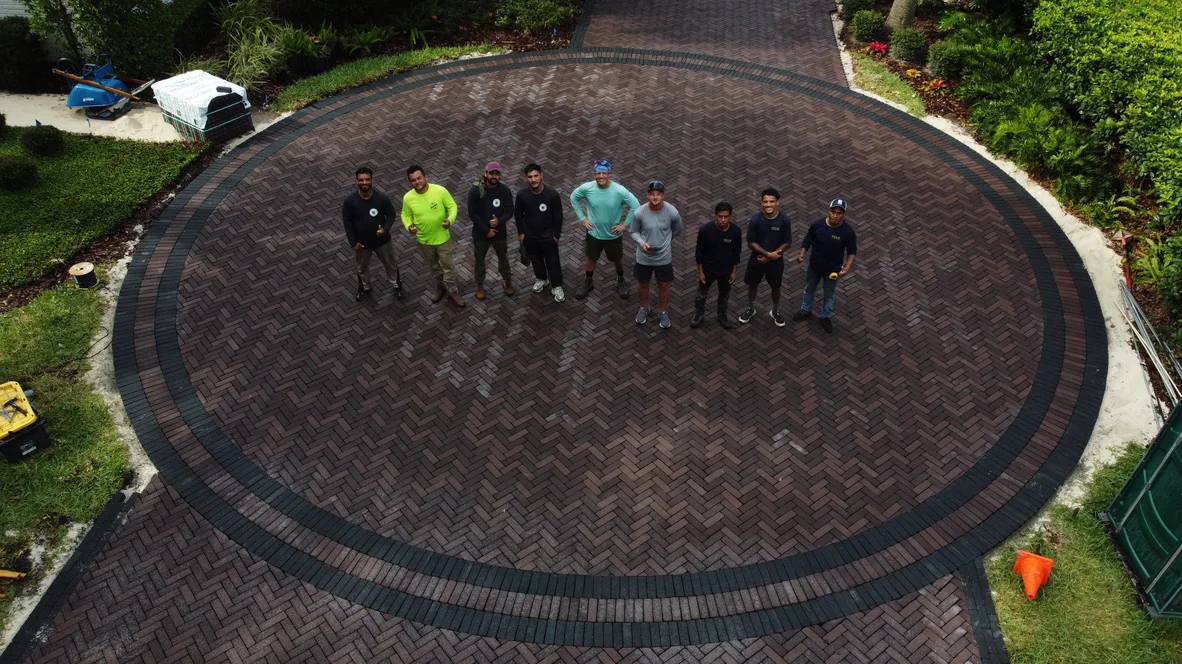
What the install days actually look like
The sequence rarely changes, only the duration of each part.
Demolition, if there is something to remove. An existing slab coming out adds time and changes how spoil leaves the property.
Excavation. Digging to the depth the soil and use actually require. On sandy lots this often goes deeper than people expect.
Base and compaction. Built up and compacted in layers rather than filled and rolled once. This is the longest stage and the one that decides whether the patio is still flat in ten years.
Bedding and laying. Screeding the bedding layer, then setting the field. Cuts around edges, curves and obstacles take longer than straight runs.
Edge restraint, joint sand and cleanup. Locking the perimeter, sweeping in joint sand, compacting the field, and clearing the site.
What genuinely adds days
Access. If a machine cannot get to the back of the house, spoil goes out and base material comes in by hand. It changes the whole staging of the job, which is why access gets confirmed before quoting rather than after.
Removing an existing surface. Slab demolition is real work and real disposal.
Built-in features. Seating walls, steps, fire features and lighting each add their own stage.
Weather. Summer afternoon storms are a fact of life here. Saturated ground cannot be compacted properly, and a good crew will wait rather than build on it. A day lost to weather is cheaper than a patio that settles.
What adds less than people expect
Size, past a point. Doubling the square footage does not double the timeline, because mobilisation, excavation setup and base logistics are largely fixed. A larger simple patio is often quicker than a small complicated one.
Pattern choice, mostly. A more intricate pattern means more cuts, which is hours rather than days on a typical residential job.
Planning it sensibly
If you want to be using a patio by a particular date, work backwards and start with the association review, not the install. That is the step you control least.
For a spring or early summer target, starting conversations over winter is comfortable. Deciding in April that you want it finished for Memorial Day is tight once review and scheduling are accounted for.
Common questions
Can you work in the rain?
Some stages tolerate it, others do not. Compaction on saturated ground is the one worth stopping for, because it compromises the base you are paying for. Expect a good crew to pause rather than push through.
Will my yard be unusable the whole time?
The work area will be, and there will be material and machinery staged somewhere. On tight lots with no rear access, more of the property is affected because everything moves through the side yard. That is worth discussing before the first day rather than discovering it.
Do you do the whole job in one visit?
Usually. The exceptions are jobs staged around other trades, such as a pool going in first, or a patio that waits on a specific material.
How far out are you booking?
It moves with the season. Ask when you get the quote, and ask again if you sit on the decision for a few weeks, because the slot you were quoted against may not still be there.
Get a real date, not an estimate
Helm Outdoor Solutions installs paver patios across St. Augustine, St. Johns County and select Jacksonville neighborhoods, and every proposal comes with a schedule rather than a vague window.
Timelines shift by neighborhood, largely because review requirements differ. The local pages cover what tends to apply where: paver patios in Ponte Vedra and paver patios in St. Johns.
Call (904) 915-3667 or send us your project details for a written, site-specific estimate.