
Pool decks are the one surface on a property where comfort beats appearance, and most people work that out the hard way in July.
A deck can look superb and still be unusable barefoot at two in the afternoon. It can photograph beautifully and be slick the moment someone climbs out. Choosing well here means weighting the criteria differently than you would for a patio.
Heat underfoot is the first filter
Surface temperature is driven mostly by colour and, to a lesser degree, by the material’s density and porosity. Light, porous materials run cooler. Dark, dense ones absorb and hold heat.
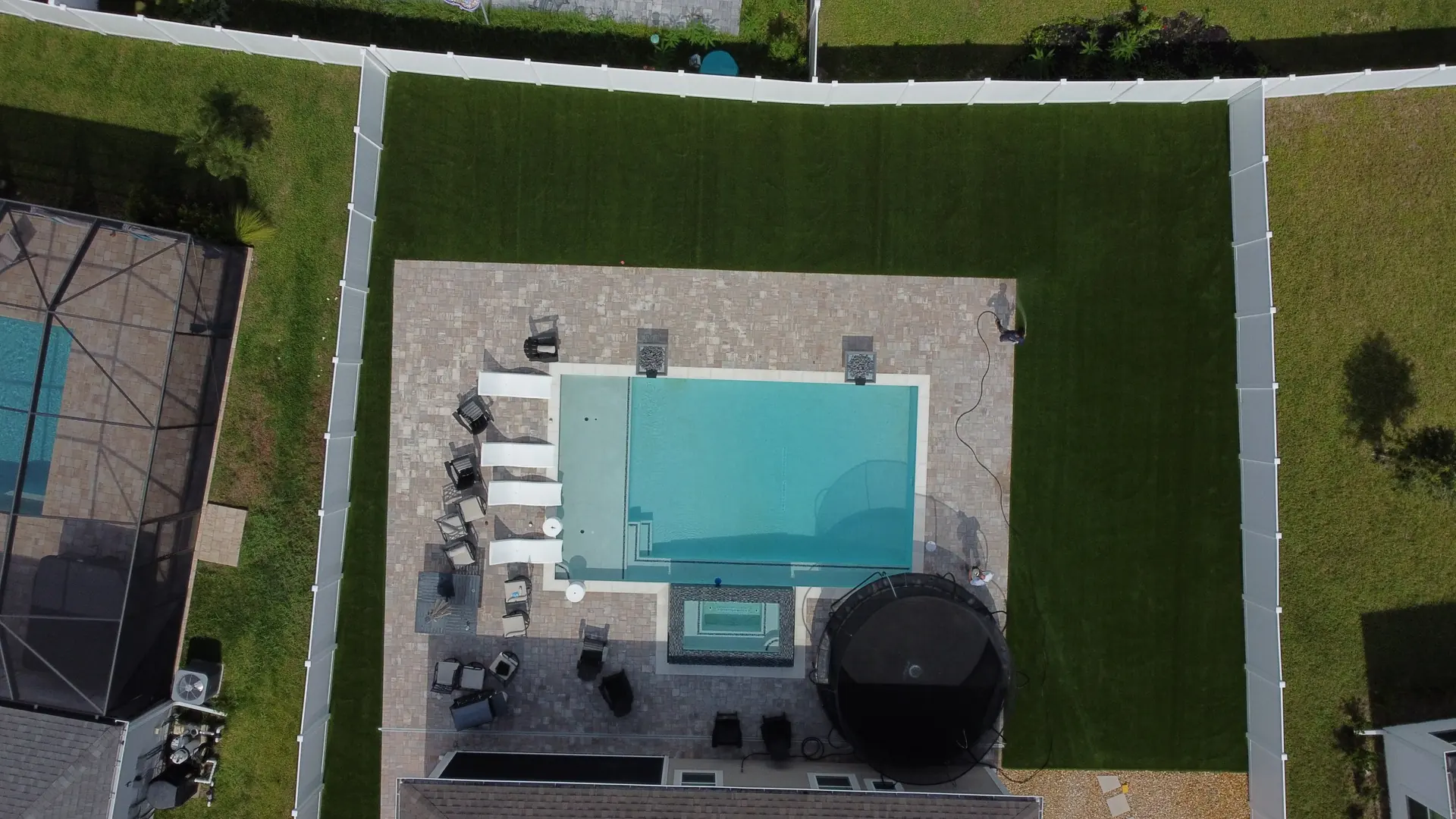
That is why travertine turns up so often around pools in Florida. It is pale and porous, and it stays noticeably cooler underfoot than a dark concrete paver in the same sun. Marble behaves similarly.
Concrete pavers are not out of the running, but colour choice does more work than people realise. A light concrete paver is far more comfortable than a charcoal one, regardless of what else is in the specification. If you love a dark paver, put it on the patio and keep the pool surround light.
Traction, wet and barefoot
The relevant question is not how a sample feels dry in a showroom. It is how the finished surface behaves wet, under a bare foot, with someone moving quickly.
Texture matters more than material category here. A tumbled or brushed finish gives more grip than a polished one. Polished marble looks extraordinary and is the wrong choice immediately around water.
Worth asking to see and stand on a wet sample rather than a dry one. Suppliers will do this if you ask, and it tells you more in thirty seconds than any spec sheet.
Chlorine, salt and what actually degrades
Saltwater systems and chlorine both take a toll, but rarely on the paving itself.
Natural stone like travertine and marble is calcium based, so acidic pool chemistry can etch it over time if spills are left sitting. In practice this is a maintenance habit rather than a reason to avoid the material: rinse spills, do not let chemicals pool on the surface, and keep dosing equipment off the deck.
Concrete pavers handle pool chemistry well. Efflorescence, the white haze that can appear on new concrete products, is cosmetic and usually resolves over the first year.
What genuinely fails near a pool is metal. Fixings, edge restraint and any hardware in steps or walls should be specified for the environment from the start. That is true anywhere in a coastal county and doubly so within a few feet of salt water.
Coping is a separate decision
The coping, the edge that caps the pool shell, does a different job than the deck. It is what people grab, sit on and push off from, so the edge profile matters.
A bullnose or rounded profile is kinder to hands and shins than a square edge. Coping also does not have to match the deck exactly. A deliberate contrast often reads better than a near-match, and it gives you a clean visual line around the water.
Where the money goes
Broadly, concrete pavers sit at the accessible end, travertine in the middle, and marble at the top, though ranges overlap heavily depending on format and grade.
Two things matter more than the headline material price. First, the base underneath is the same work regardless of what goes on top, and it is a substantial part of any pool deck job. Second, cuts around a curved pool shell take time, and a freeform pool costs more to deck than a rectangle in the same square footage.
If budget is tight, a light concrete paver laid on a properly built base will serve you far better than a premium stone laid on a base that was rushed.
Replacing an existing deck
If you are re-decking around an existing pool, two things need checking before anything else.
What is the current deck sitting on, and is it still sound? And where does water go when it leaves the deck? Pool decks generate a lot of runoff, and an older deck that has been quietly sending water toward the house is a problem worth solving while the surface is off.
Finished height also needs thought. It interacts with coping, with door thresholds, and with any existing steps.
Common questions
Which material stays coolest?
Light, porous materials. Travertine has the strongest reputation for it and deserves it, with marble comparable. A pale concrete paver performs far better than a dark one. Colour is the biggest single lever you have.
Does travertine need sealing?
It is optional and it is mostly about stain resistance and appearance rather than structure. A sealed surface resists marks better and needs redoing periodically. Some owners prefer the unsealed look and simply rinse spills promptly.
Can I put pavers over my existing concrete pool deck?
Sometimes, but it raises finished height, which affects coping and thresholds, and it means building over a base nobody has inspected. If the existing deck is cracking, whatever caused that is still underneath.
Is a paver deck slippery?
Not inherently. Finish drives it. Tumbled and textured surfaces give good wet grip; polished finishes do not. Ask to stand on a wet sample.
Look at it around your actual pool
Helm Outdoor Solutions designs and installs pool decks in concrete pavers, travertine and marble, alongside wider hardscape work, across St. Augustine, St. Johns County and select Jacksonville neighborhoods.
Orientation, shade, pool shape and where runoff currently goes all change the recommendation, which is why the material conversation happens at the property rather than over a sample board.
Call (904) 915-3667 or send us your project details for a written, site-specific estimate.
Related reading
- Paver Patio vs Concrete Slab: What Actually Holds Up in Northeast Florida, the paver versus concrete question in general.
- What Goes Under a Paver Patio: Base, Bedding and Why Some Patios Sink, what sits under the surface either way.