
Hardscape is not a surface you redo when you get bored of it. A patio is a fifteen to twenty year decision made in an afternoon, usually while looking at photographs of other people’s backyards.
The choices that go wrong are rarely the expensive ones. They are the fashionable ones. Here is what tends to hold up, and what tends to date.
Take the proportions seriously before the pattern
The most common regret we hear has nothing to do with material. It is that the patio is too small to use properly.
People size a patio by looking at an empty yard, which is a terrible way to judge it. A dining table with chairs pulled out needs considerably more room than the table’s footprint. A seating group needs circulation behind it. A grill needs standing space that nobody walks through while someone is cooking.
Lay it out with actual furniture dimensions and actual walking routes before anything else is decided. A generous plain patio beats a cramped ornate one every single time, and it costs less.
Let the house choose the colour
The reliable approach is to pick paving that relates to something permanent on the building. Roof tone, stone or brick detailing, trim colour. Those things are not changing soon, and paving that sits in the same family as them will still look deliberate in a decade.
What dates fastest is paving picked to match something temporary. Furniture gets replaced. Planting changes. A very specific colour chosen to coordinate with a cushion fabric is a choice you will be living with long after the cushions are gone.
Mid-tone neutrals age best, which sounds dull and is nonetheless true. They also keep your options open, because almost any furniture, planting or lighting works against them.
One feature, not four
The busiest patios are the ones where every element was chosen well in isolation.
A contrasting border, a soldier course, a decorative inlay, a change of pattern by the door, a second paver in the seating area and a feature circle all read as noise together. Each one looked good on its own in a showroom.
Pick the one that earns its place. A simple border around a plain field is the detail that has looked right for decades and will keep doing so.
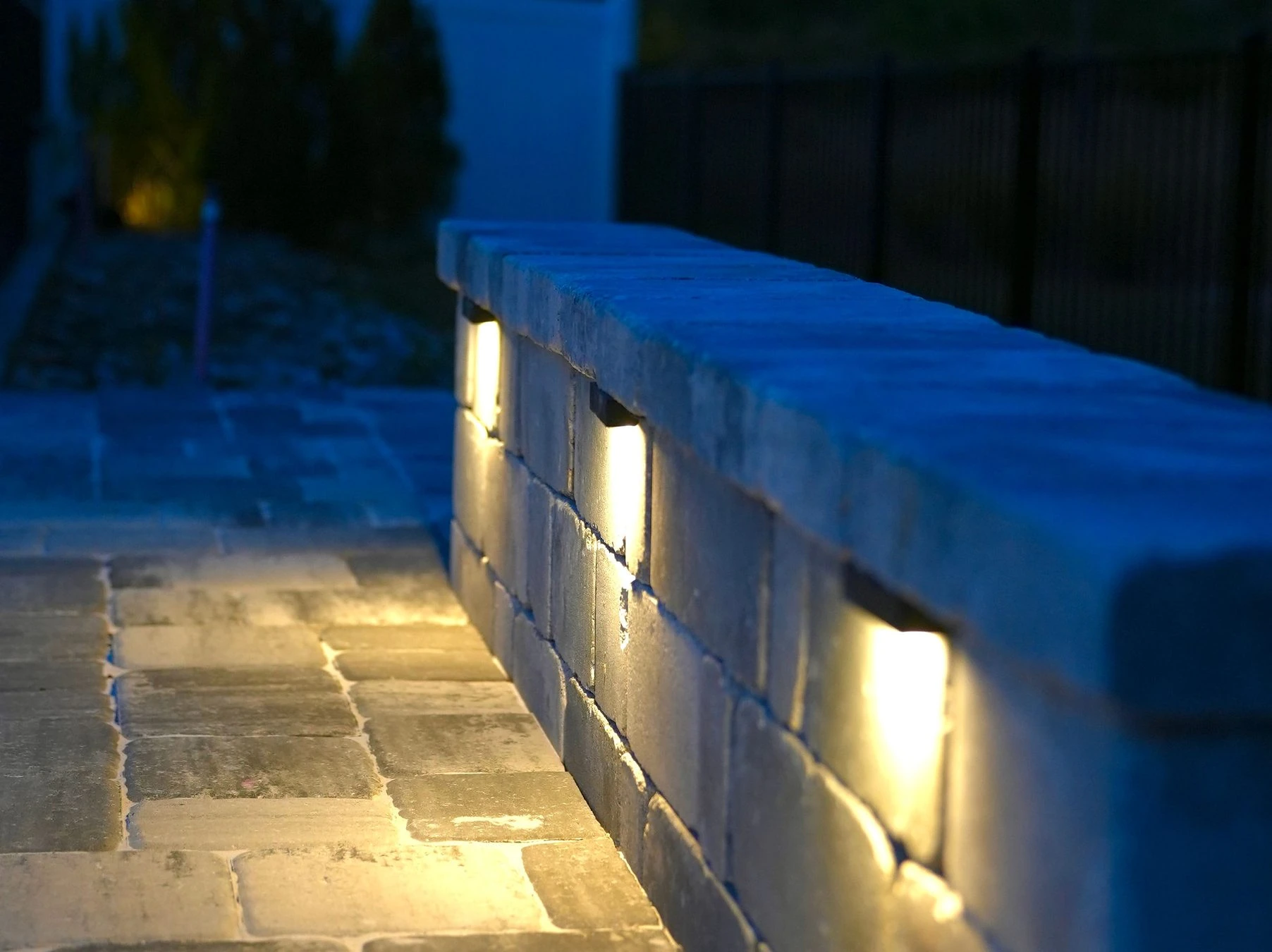
Build in what is hard to add later
Some things are straightforward to retrofit. Furniture, planters, a fire bowl, shade.
Some are not. Anything requiring a conduit or a sleeve under the paving is dramatically easier before the surface goes down than after. Lighting runs, an outlet on the far side, a gas line to a future fire feature, irrigation crossing the area.
Running a sleeve you might never use costs very little during the build. Lifting a finished patio to add one costs a great deal more. If there is any chance you will want it, put the sleeve in.
Lighting changes how much you use it
This is the upgrade people underestimate most.
An unlit patio is used in daylight. A lit one gets used after dinner, most of the year, which in this climate is a lot of evenings. Low level lighting into steps, seating walls and the edges of the space does more for how often a patio earns its keep than almost any material decision.
It also wants planning at build stage, which brings us back to sleeves.
Shade is part of the design, not an accessory
A patio in full afternoon sun in Northeast Florida gets used less than its owners imagined when they were planning it in March.
Work out where the sun actually falls at the times you intend to use the space, then decide what is providing shade and where it will sit. A pergola, a sail, an umbrella with somewhere sensible to stand, or an existing tree worth designing around. Deciding this at layout stage usually changes the layout, which is the point.
What ages badly
Very high contrast colour pairings. They look sharp on day one and emphatically of their moment later.
Highly specific decorative inlays and medallions. They commit the space to one look permanently.
Undersized everything. Narrow steps, thin borders, a patio that barely fits the furniture. Scale is what separates considered from cheap, and it does not improve with time.
Multiple competing materials in a small area. Two is usually plenty.
Common questions
Should the patio match the driveway?
Related rather than identical is usually the stronger answer. Sharing a colour family while differing in format or laying pattern reads as intentional. An exact match across the whole property can feel flat, and a total mismatch looks accidental.
Do borders actually matter?
Visually, a border gives the field a finished edge and hides the cut line, which is why it looks deliberate. Structurally it is the edge restraint doing the work, not the border course. Do not treat a border as a substitute for proper restraint.
Is a bigger paver format better?
Large formats read calm and modern and suit generous spaces. Smaller units handle curves and level changes more gracefully and are more forgiving in tight areas. The space should choose, not the trend.
Can I extend a patio later and have it match?
Sometimes, and it depends on whether the paver is still in production and how much the original has weathered. If you think an extension is likely, either build the full footprint now or plan the extension as a deliberately different zone rather than hoping for an invisible join.
Plan it where it is going to be
Helm Outdoor Solutions designs and installs paver patios across St. Augustine, St. Johns County and select Jacksonville neighborhoods, and layout gets worked out on the property where sun, sightlines and circulation are visible.
Lot shapes and orientation differ a lot by neighborhood. The local pages cover what tends to come up: paver patios in Julington Creek and paver patios in San Marco.
Call (904) 915-3667 or send us your project details for a written, site-specific estimate.