
Artificial turf has got good enough that the argument is no longer about whether it looks real. It is about whether it suits the specific patch of ground you are thinking of putting it on.
Some yards it transforms. Others it is the wrong answer and an expensive one. Here is how to tell which you have.
Where turf genuinely wins
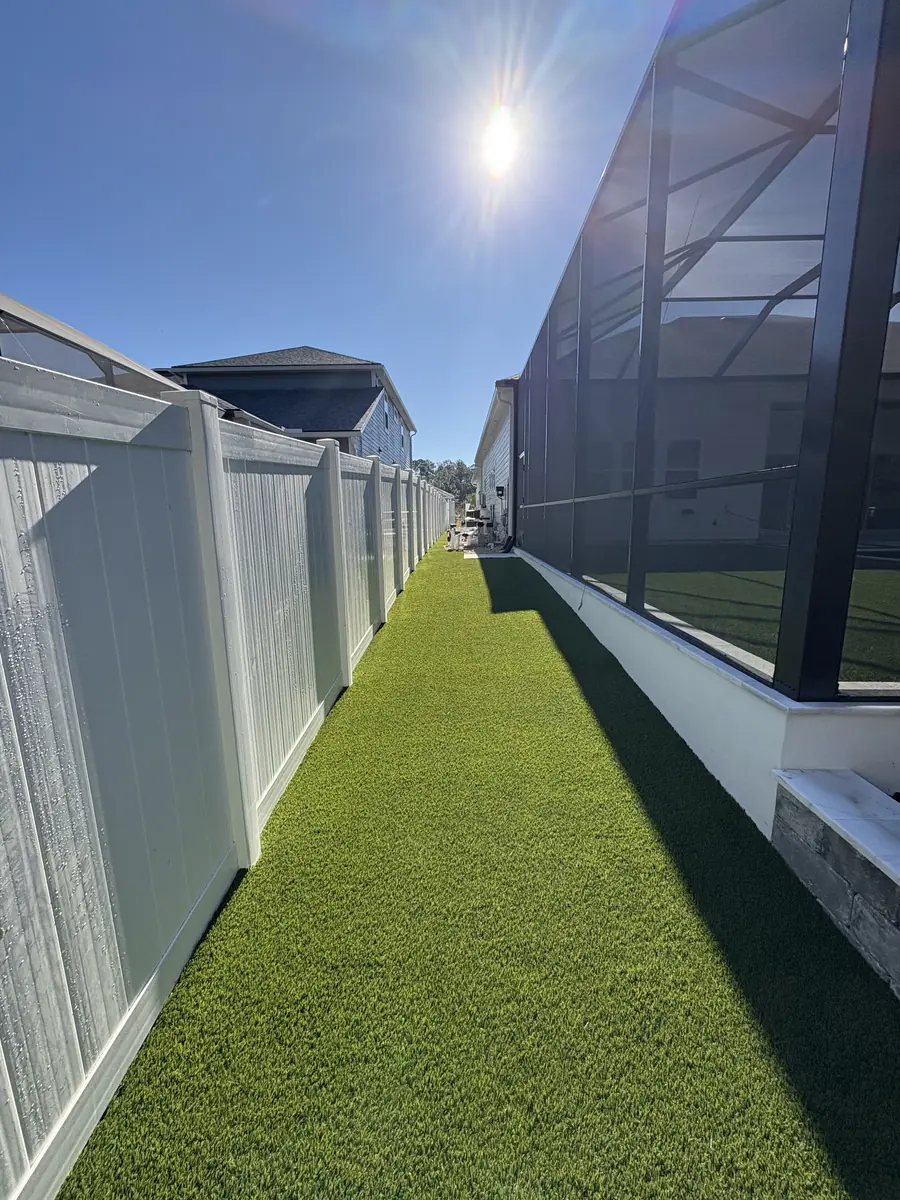
Deep shade. This is the strongest case. Grass needs light, and the strips beside a house, under a live oak canopy or between a screen enclosure and a fence often never get enough. Those areas stay thin and patchy no matter what you spend on them. Turf does not care.
Narrow side yards. Awkward to mow, hard to irrigate evenly, and usually the worst looking part of a property. Turf makes them tidy permanently.
Dog runs. Turf survives traffic that kills grass, and it does not turn into mud. It needs rinsing, and drainage under it matters more than anywhere else, but it holds up.
Putting surfaces. You cannot get a consistent roll on natural grass in a residential backyard. This is not really a comparison, it is the only option.
Anywhere mowing is genuinely difficult. Steep banks, tight enclosures, narrow gates.
Where real grass is still the better answer
Large open lawns. The cost scales linearly and the benefit does not. A big sunny lawn that grows perfectly well is an expensive thing to replace for a maintenance saving.
Full sun in high summer. Turf gets hot. Considerably hotter than grass, which cools itself by transpiring. Infill and fibre choice affect this, and a light-coloured infill helps, but physics sets a floor. If you have small children or dogs using that area barefoot at midday, walk on an installed sample in August before committing.
Where you actually enjoy the lawn. Some people like mowing and like the smell and the softness. That is a legitimate reason and not everything needs optimising.
The honest maintenance picture
Turf is low maintenance, not no maintenance, and the marketing sometimes blurs that.
You will still be brushing it to keep the fibres upright in traffic areas, rinsing it, clearing leaves and debris before they break down into the infill, and topping up infill over the years. With pets you will be rinsing more often. Weeds can establish in accumulated organic matter on the surface even though nothing grows through the backing.
What you are actually buying back is the mowing, the watering, the fertilising and the seasonal patchiness. That is a real saving in time and in water, just not a zero.
What decides whether it lasts
The same thing that decides whether a patio lasts: what is underneath.
Turf goes over a compacted aggregate base, not over the existing lawn. That base has to drain, because water that cannot get away sits under the backing and creates smell and soft spots. On a lot where water already pools, that needs solving before the turf goes down, not after.
Edges need proper restraint for the same reason paving does. Turf that is not anchored at the perimeter lifts and curls, and that is the most common failure you will see on a cheap install.
Seams are the other tell. A good installation hides them. A rushed one shows a line across the lawn in raking light forever.
Cost, plainly
Turf costs considerably more upfront than sod and considerably less to run. Whether it pays back depends on how much area, how much you currently spend on water and lawn care, and how long you plan to stay.
The variable people miss is that the base preparation is a real part of the cost and it is not the part to economise on. A premium turf on a poor base looks worse in three years than a mid-range turf on a good one.
The hybrid most people end up with
Very often the right answer is not either. It is turf in the shaded side yard and the dog run, grass in the open sunny lawn, and paving where people actually sit.
Deciding by zone rather than by property is usually cheaper and almost always better.
Common questions
Does turf get too hot for dogs?
It can in full sun at midday. Shade, a lighter infill and rinsing before use all help. If the area is unshaded and used heavily in the afternoon, that is a genuine mark against it, and worth testing rather than taking on trust.
How long does artificial turf last?
Good turf on a properly built base lasts many years, with UV exposure and traffic being the main variables. The base and the edge detail usually determine when it starts looking tired, not the fibre.
Does it drain?
The turf itself is perforated and drains readily. Whether your yard drains is a separate question, and it is the one that matters. If water currently sits somewhere after a storm, it will still sit there with turf over it.
Can turf go over an existing lawn?
It should not. Organic material underneath decomposes, settles unevenly and holds moisture. The existing lawn comes out and a proper base goes in.
Look at the specific area
Helm Outdoor Solutions installs artificial turf alongside landscape design and installation across St. Augustine, St. Johns County and select Jacksonville neighborhoods.
Sun exposure, drainage and how the space is used decide whether turf is right, and those get assessed at the property rather than from a square footage figure.
Call (904) 915-3667 or send us your project details for a written, site-specific estimate.